
2022 Wasatch 100
September 9, 2022
By Dana Miller
5-time winner, 20-time finisher
On the Wednesday before the Wasatch 100, three hundred anxious entrants saw temperatures hit 105 degrees in the Salt Lake Valley. By check-in time on Thursday, it was only 98 degrees and the forecast for the race’s 36 hours predicted further cooling to the mid-80’s. The runners’ collective sigh of relief was short-lived.
 Deseret News Race Day Headline
In southern California, 700 miles away, wildfires raged out of control. Strong south winds brought cooler temperatures but carried thick smoke with them, filling northern Utah’s valleys. The high-pressure system acted like a lid, keeping the crud locked in place.
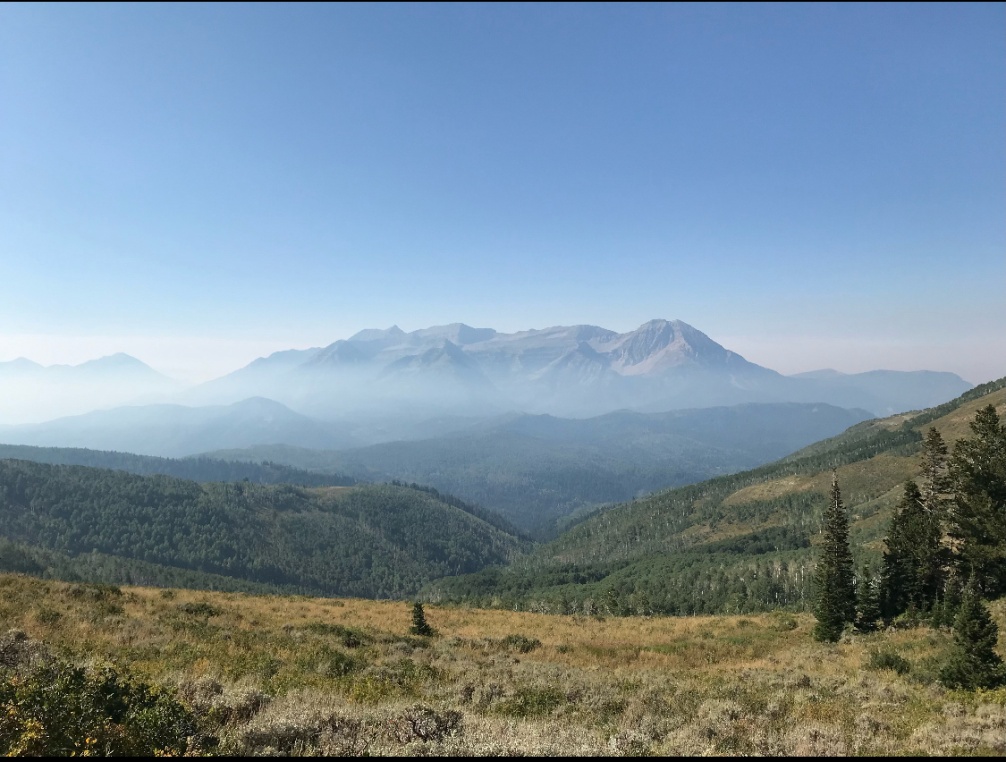 A layer of wildfire smoke awaits runners with
Mount Timpanogos in the distance
Photo courtesy of William Wittwer
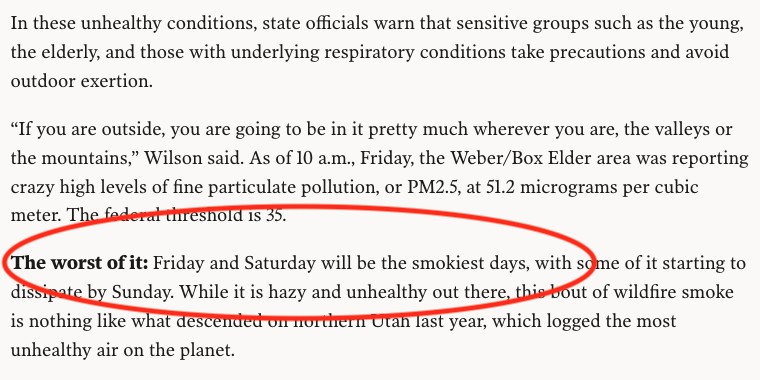
Mother Nature’s timing is perfect
“…avoid outdoor exertion” – right!
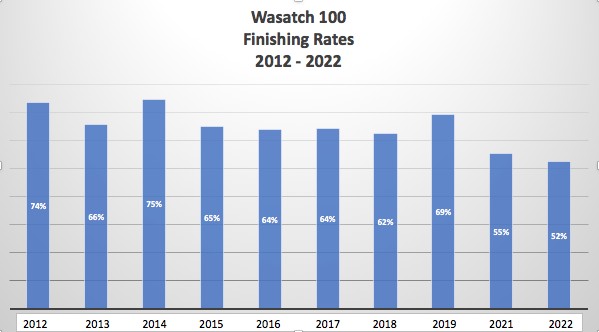
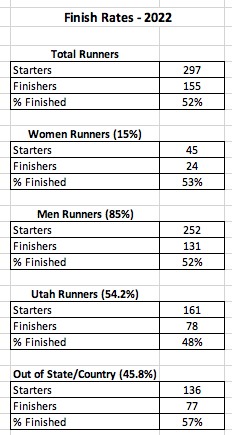
It’s impossible to determine the impact high temperatures and miserable air quality had on the 297 runners that started the race at East Canyon Wilderness Park on Friday morning at 5 a.m. However, only 155 would make it to the Soldiers Hollow finish line within 36 hours. The 52% finisher rate was the lowest in the past 34 years. Except for Wasatch’s first 3 years (1980 – 1982), 51% is the race’s lowest finish rate (1983 and 1988).
Despite the heat and smoke, the 2022 Wasatch 100 saw impressive wins by Salt Lake City’s Shawn Smith (20:30) and Sarah Pizzo (24:47) from Steamboat Springs (CO). In addition, Colleen Ford and Carter Williams, both from Salt Lake City, each finished their 20th Wasatch 100.
Women’s winner Sarah Pizzo and third-place finisher Callie Cooper (27:51) are close friends and training partners from Steamboat Springs (CO) and planned to run together as long as possible. Topping Bair Canyon’s 4,000’ climb together (mile 6.6), the duo passed Liz Butler before Grobben’s Water Station (11.5 miles) but didn’t realize they’d taken the lead.
They picked up pacers at Big Mountain (mile 31.9) and headed towards Lambs Canyon almost 16 miles away. “Brutal” is how Sarah Pizzo described the 3 hours and 20 minutes of sun exposure and heat. In retrospect, she recognized “I went out way too hot and was in trouble at Lambs Canyon.”
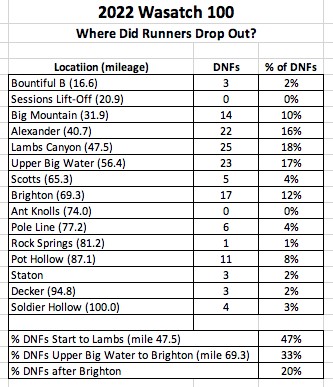
The Big Mountain (mile 31.9) to Lambs Canyon (mile 47.5) stretch is the perennial “Least Favorite Section of Wasatch” winner. Most runners traverse this rocky, exposed series of ridges and climbs in the heat of the day. It’s also worth noting that runners only have 1 aid station in the 19.8 miles from Sessions Lift-Off (mile 20.9) to Alexander Aid Station (mile 40.7). Race officials advised runners to carry at least one extra bottle of water. For some competitors, however, the resulting effects of fatigue and dehydration were a vivid lesson in self-reliance.
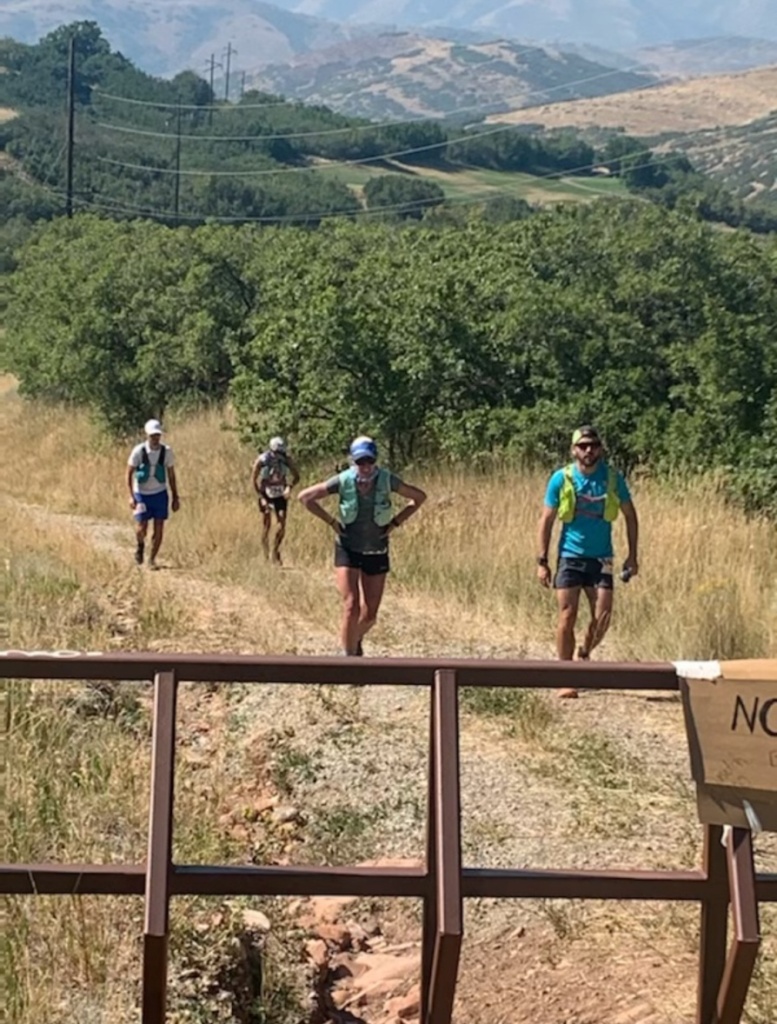 Callie Cooper (front left) hits the Lambs Canyon aid station
sharing the lead with friend Sarah Pizzo*
Liz Butler hustled into Lambs Canyon (mile 47.5) just 8 minutes behind Sarah and Callie but beat them out of Lambs on the way to Upper Big Water (mile 56.4) after a quick 4-minute refuel. Sarah and Callie were now 5 minutes behind. Butler remembers: “One of the two women ahead of me was on the ground at Lambs, obviously cramping. I didn’t know I was now in first place until Upper Big Water (mile 56.4)”.
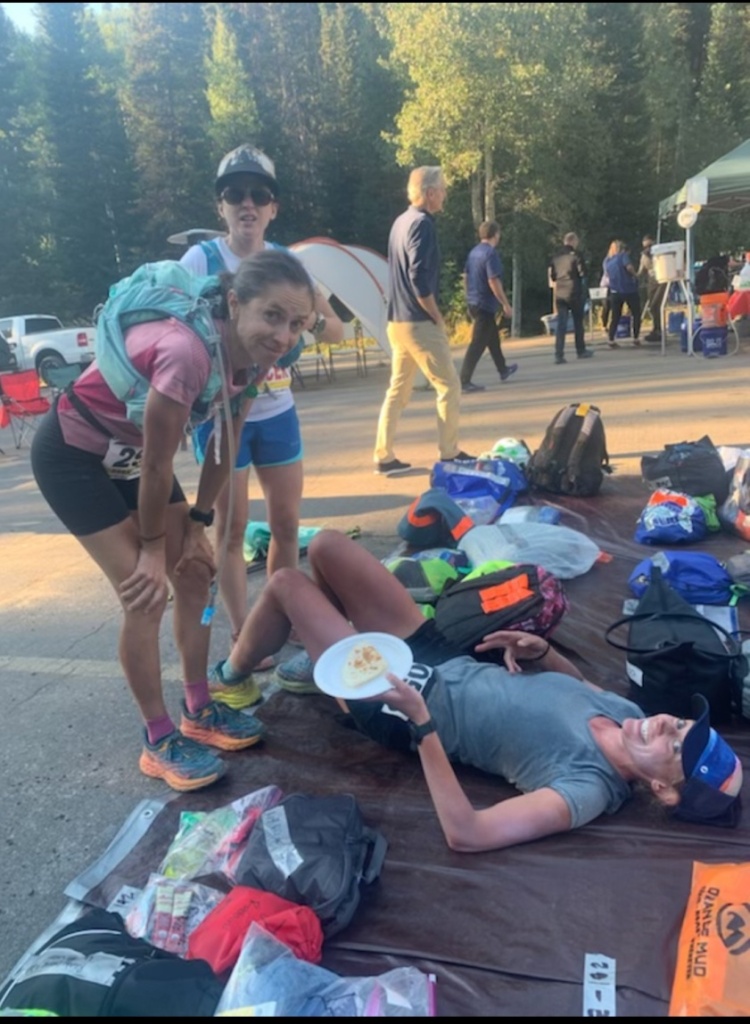 Eventual winner Sarah Pizzo (left) and friend
Callie Cooper (right) at Upper Big Water Aid Station*
In the men’s race, the pace up Bair Canyon created a small gap at the front of the pack. 33-year old Shawn Smith, Director of Operations at Salt Lake City’s Uintah Brewing Company, called it “a fun way to start the day”. He topped the canyon with just one fellow runner in tow but quickly pulled away on the downhill to Grobbens Water Station (mile 11.5). His 2:44 marathon speed made short work of the 3.5-mile gravel road. Shawn played soccer growing up in Nebraska and ran his first 50k in 2013. Shawn said he’d trained on every accessible section of the course and “wanted to see what I could do on home trails and have fun with my friends.” If everything went perfectly, he hoped to go under 20 hours and post a top 10 all-time finishing time. But, he knew he still had 93 miles to worry about. “Am I going too hard? What am I doing?” he wondered.
Just 5 minutes behind Smith at Bountiful B (mile 16.6), Grant Hotaling (CA) and Jose Cruz (UT) were just beginning their near day-long battle for 2nd place. Grant recalls: “Shawn had a day…I never saw him the entire race! I had a back and forth going with Jose Cruz. I’d get him on the climbs then he would pass me on the downhills.” Both Hotaling and Cruz were running strong races, hitting their split times in hopes that they’d reel in Smith, who was holding strong.
Hotaling had won the Tahoe Rim 100-mile race in 2021 and posted top 5 finishes in 50k, 50-mile and 100k races in the summer leading up to Wasatch. Cruz finished 2nd in Wasatch in 2021 (21:51) after finishing 3rd in the Bryce Canyon 100 in 2020. Both knew they could run a fast time so focused on running their own races.
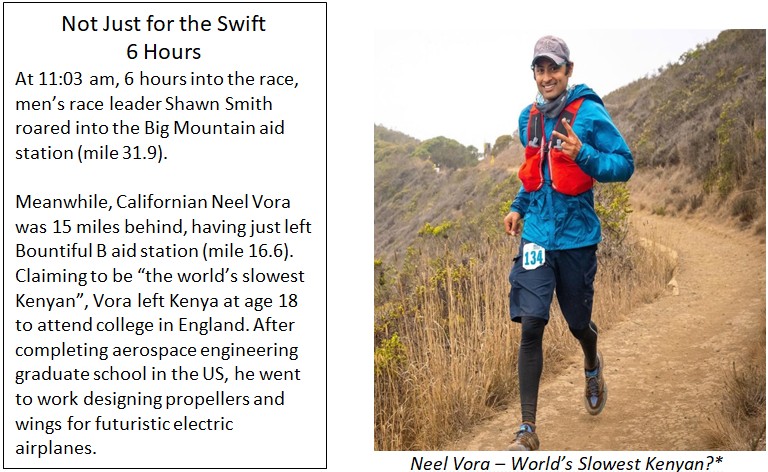
Although Shawn Smith was having a great day, not everything was going his way. One key was making it from Big Mountain (mile 31.9) to Lambs Canyon (mile 47.5) through the heat of the day without letting the heat and smoke do too much damage. Cruising into the Big Mountain aid station with a 27-minute lead, he was eager to greet his crew, drink extra fluids, grab an ice-packed bandana and take a few extra minutes. But, his crew wasn’t there! He remembers: “I had to go into problem solving mode and knew I couldn’t make a mistake.” Keeping a cool head, he took advantage of the aid station offerings and headed off to Alexander, almost 9 hot miles away. At Alexander (mile 40.7) he remembers “hurting a little bit due to the heat because I didn’t have everything I needed.” By the time he got to Lambs Canyon (mile 47.5) and finally met his crew, his lead had stretched to 45 minutes. Here he switched from a waist pack to a vest, got that much-needed iced bandana and was off to Upper Big Water after a quick 6-minute stop. Posting a blazing 1:52 split to Upper Big Water (mile 56.4), Smith was “happy to get to Millcreek where I do a lot of training and started really having fun.” Asking about the widening gap back to 2nd place, he knew he still had to stay focused on his own race.
 Shawn Smith ties on an iced bandana
at Lambs Canyon with a 45-minute lead*
After trail dancing past Dog Lake, Desolation Lake and Scotts Pass, Smith encountered another race day hiccup at Brighton (mile 69.3). After learning that his pacer wasn’t there yet, he downed his customary late race Red Bull and headed off towards Catherine Pass, telling his crew to have Nate Hayward, a close friend, try to chase him down. Nate arrived within minutes and caught Shawn on the climb to Lake Mary. With “lightened spirits”, by Ant Knolls (mile 74) he began to comprehend that he could win unless something catastrophic happened.
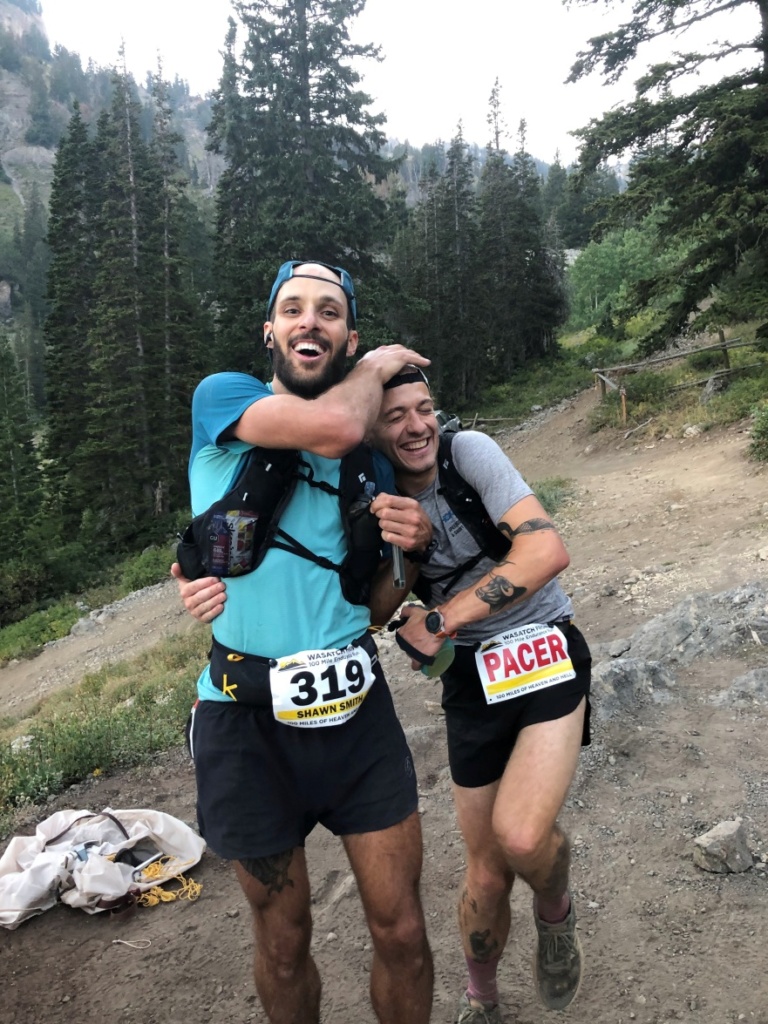 Shawn Smith in great spirits at Ant Knolls with
pacer and friend Nate Hayward*
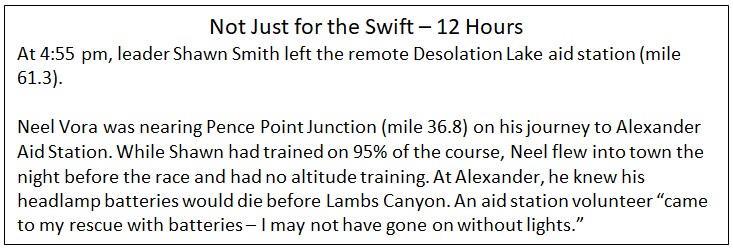
Women’s leader Liz Butler had monitored her water and salt intake carefully all day, filling extra bottles at Sessions Lift-Off (mile 20.8) and Big Mountain (mile 31.9). “I’d rather carry too much than not enough water” she reasoned. Her right ankle started hurting on that cobble rock stretch. “I thought maybe it was my shoes but, because I run without a crew, my shoes were in my Brighton drop bag over 30 miles away.”
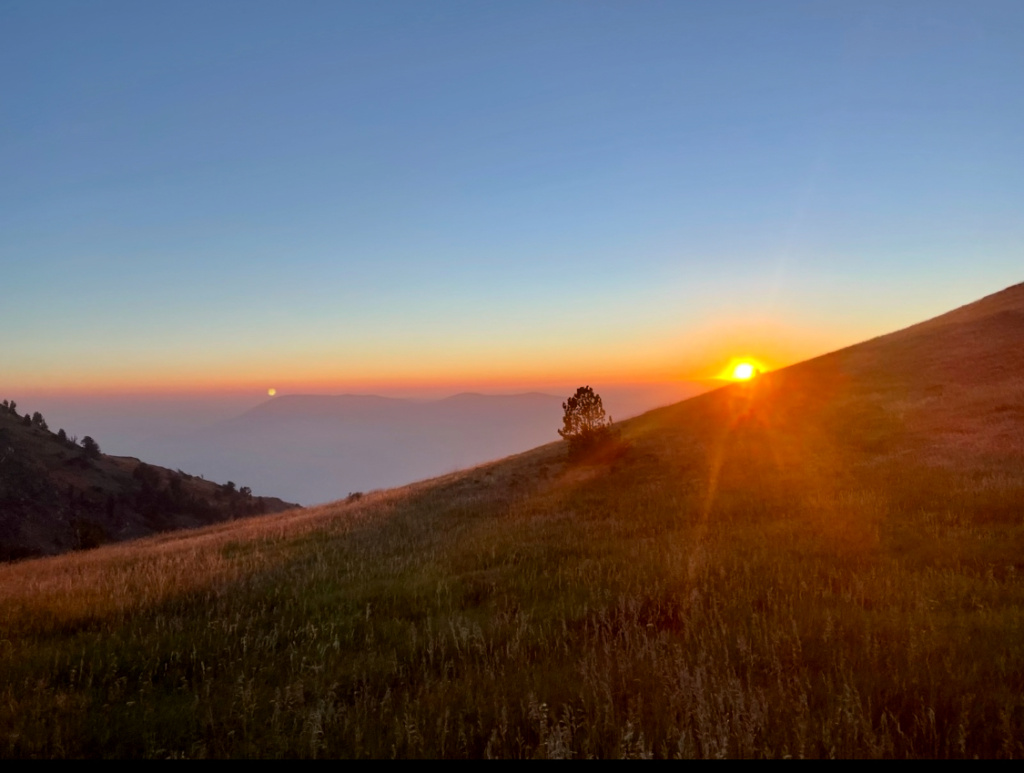 Spectacular but smoky sunset near Desolation Ridge
Photo courtesy of Liz Butler
Despite her worsening ankle pain, Liz Butler widened her lead over Pizzo and Cooper to 33 minutes at Brighton (mile 69.3). A much-anticipated change of shoes didn’t ease the pain. After a slow climb to the race’s 10,233’ high point at Catherine Pass, Liz realized it was “hang on for dear life” time as the steep, technical descent to Ant Knolls aid station (mile 74) made her strongly consider dropping out. “I was hobbling. It was the most frustrating experience. ‘Normal’ problems are fine but I couldn’t do anything about my ankle.”
Sarah Pizzo and Callie Cooper parted company before Upper Big Water (mile 56.4) but Sarah’s lead over Cooper was only 4 minutes at Brighton (mile 69.4). The climb to Catherine Pass and rocky freefall to Ant Knolls (mile 74) proved Cooper’s undoing. Up ahead Pizzo began closing in on Liz Butler. She was 42 minutes behind at Pole Line (mile 77.2), 10 minutes behind at Pot Hollow (mile 87) and just 2 minutes at Staton (mile 90). “I caught her just before Top of the Wall (mile 91.8). I could tell she was going as fast as she could. I figured if I could keep running, I had the win”, Sarah Pizzo recalls thinking. Running strong to the end, Sarah finished in an outstanding 24:47, in 7th place overall.
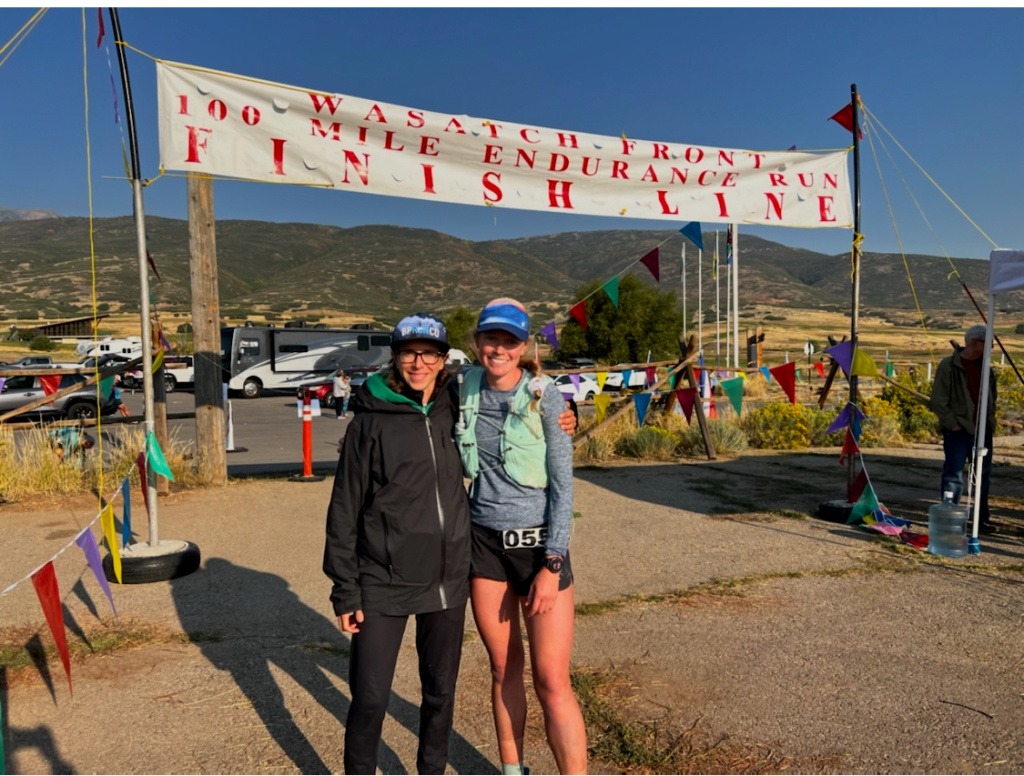 Sarah Pizzo (left) celebrates her 24:47 victory with
friend Callie Cooper (right) who finished 3rd in 27:51*
Sarah, an attorney, says “I went into it feeling ‘ho-hum’ about the race and was sort of going through the motions, thinking I’ll be lucky if I finish.” Reflecting on the race, she recalls “I was most surprised by the heat, I didn’t expect it to be near 100 degrees. I wasn’t prepared for that mentally. I was also surprised by how remote the course is – it was a little frightening not to know where I was going, looking for the next flag.”
Liz Butler wasn’t the only lead woman felled by an injury. Callie Cooper had been dealing with increasing hip pain caused by a congenital abnormality. “My hip finally fell apart at Brighton and I ended up basically dragging my leg the rest of the way,” she lamented. (2025 Note: Callie had both hips surgically rebuilt the following spring and is experiencing a slow recovery.) Liz gritted her teeth and hung on for a solid 2nd place 25:39 finish, 11th overall. Cooper came in 3rd in 27:51.
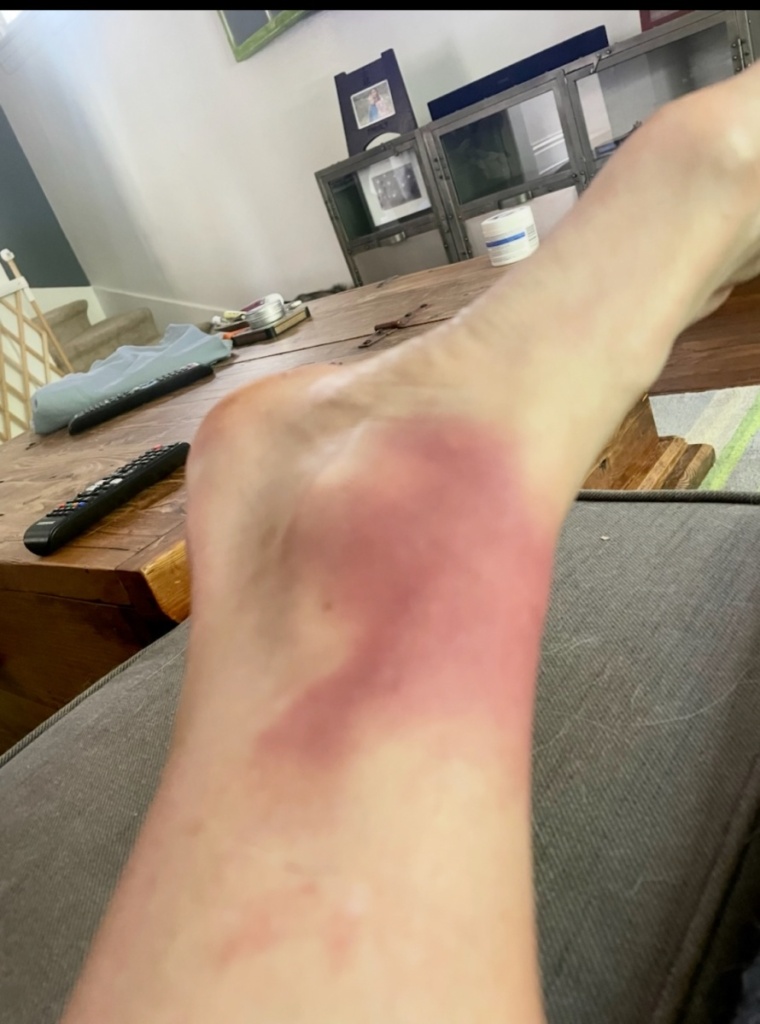 Liz Butler’s ankle several days after Wasatch*
The Deseret News’ pre-race air quality warning proved true for 7-time finisher Andrew Wittwer. Suffering from asthma, he was a member of one of those “sensitive” groups who should “avoid outdoor exertion” for the days including Wasatch. Climbing up Bair Canyon, he realized he couldn’t take a full breath and knew he was in for a struggle. He began falling behind his projected splits as early as Sessions Lift-off (mile 20.3) and was worried about meeting cut-off times all the way to Brighton (mile 69.4). After giving his lungs a break by sleeping in his car for a while, he left Brighton at 6:18 am. “It was touch and go all the way to the end but I just kept going. It was a long, hard day.”
Paced by his 29-year old son William, he made it to the Soldier Hollow finish with 19 minutes to spare (35:40:59). His effort was celebrated by his family, including 3 grandchildren. Fittingly, his Dad observed: “It was one of your slowest times but one of your best finishes.”
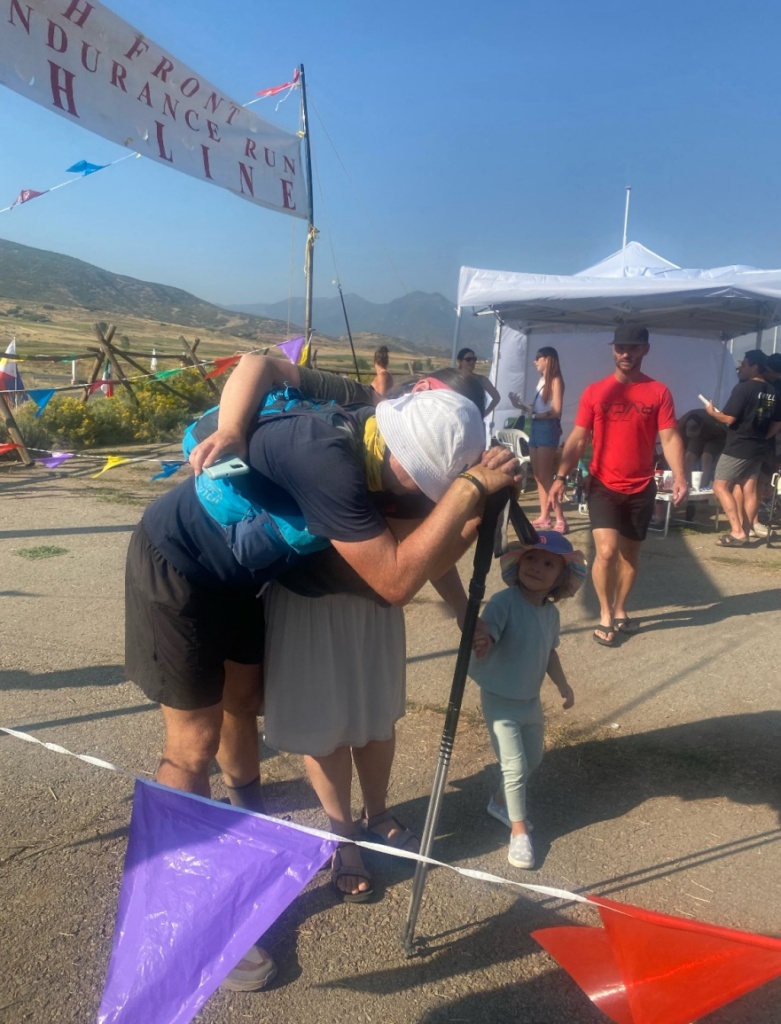 Andrew Wittwer totally spent after battling asthma
for nearly 36 smoky hours*
Shawn Smith only spent a combined 29 minutes in the aid stations. His sole “rough patch” of an otherwise magical day struck between Ant Knolls (mile 74) and Pole Line (mile 77.2) where he “was able to get some calories in. After that I had a good time laughing and running.” His time for the 22.8 miles from Pole Line to the finish was an incredible 4 hours 2 minutes. It’s hard to imagine 10 minutes 36 seconds per mile out to Rock Springs and through Irv’s Torture Chamber to the end. He finished in 20:30:28, the fastest finishing time since 2014.
In the race for the remaining podium spots, Cruz led Hotaling by just 5 minutes at Lambs Canyon (mile 47.5). By Upper Big Water (mile 56.4) Hotaling had passed Cruz and stretched his lead to 22 minutes by Brighton (mile 69.4) and maintained it past Rock Springs (mile 81.2). Irv’s Torture Chamber proved more tortuous to Hotaling than Cruz. Cruz closed the gap to 5 minutes by Decker aid station (mile 94.8). Seeing Cruz’s headlamp behind him, Hotaling didn’t stop and pushed all the way to Soldier Hollow with Cruz’s light a constant reminder that he couldn’t slow down. Hotaling finished 2nd in 22:43 and Cruz 3rd in 22:48, his second podium finish. Brandon Dase (UT) pulled away from Tyler Fannin (UT) in the last 5 miles, rounding out the Crimson Cheetah sub 24-hour inductees, finishing just 19 seconds apart in 23:56:00 and 23:56:19.
 2nd place finisher Grant Hotaling safely back
in Santa Rosa (CA) running the family bookstore*
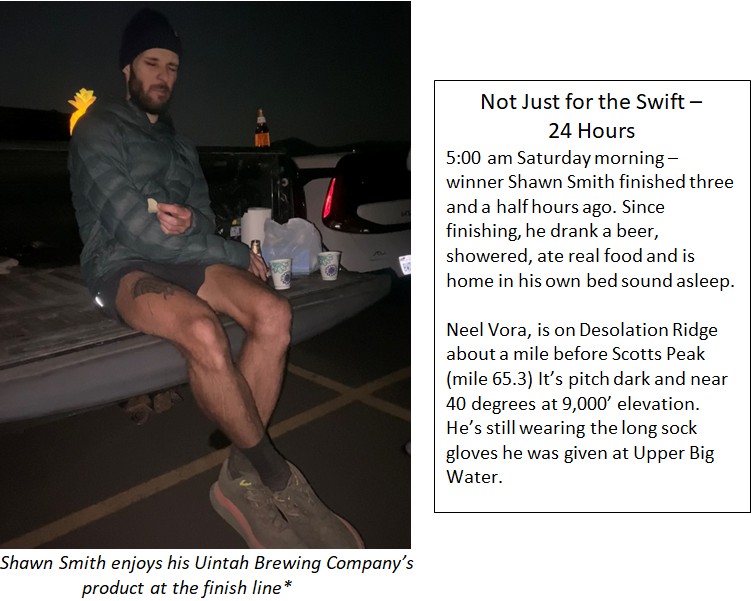
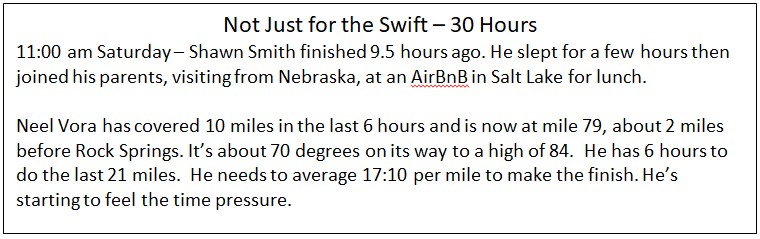
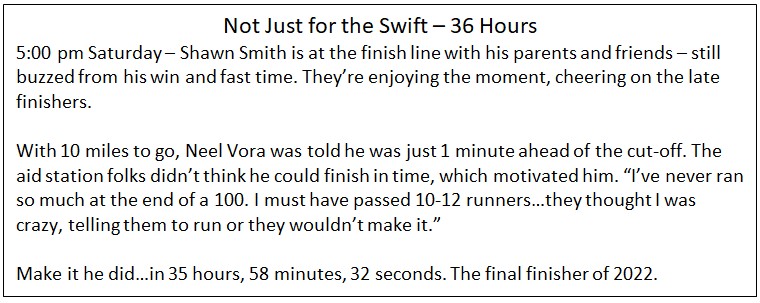
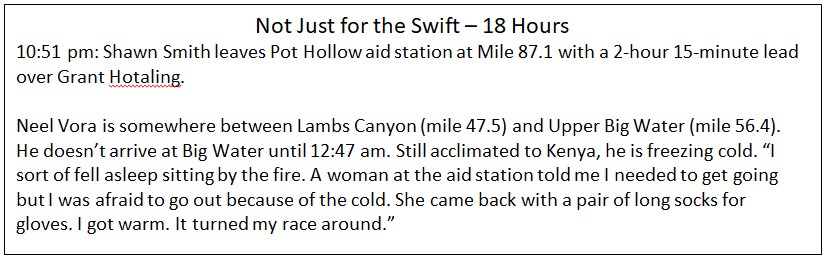
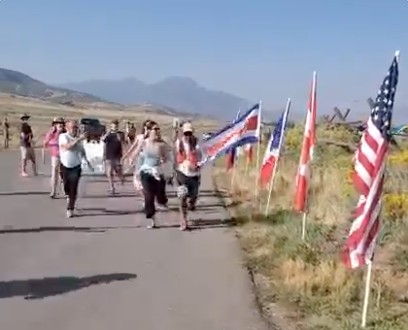 Neel Vora, self-proclaimed ‘World’s Slowest Kenyan’,
2022 Wasatch’s last finisher
Photo courtesy of Brian Wade
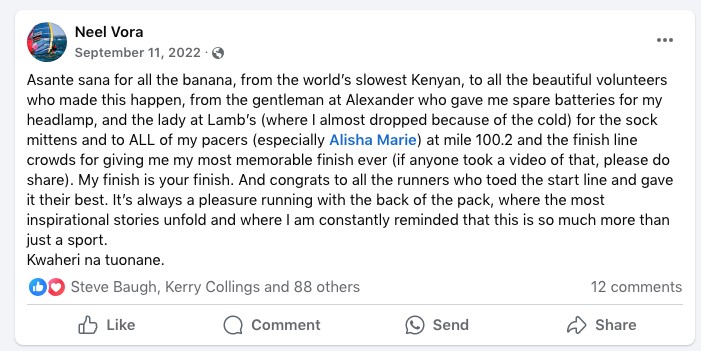 Neel’s post-race Facebook sentiment captures
the essence of finishing the Wasatch 100
no matter how long it takes*
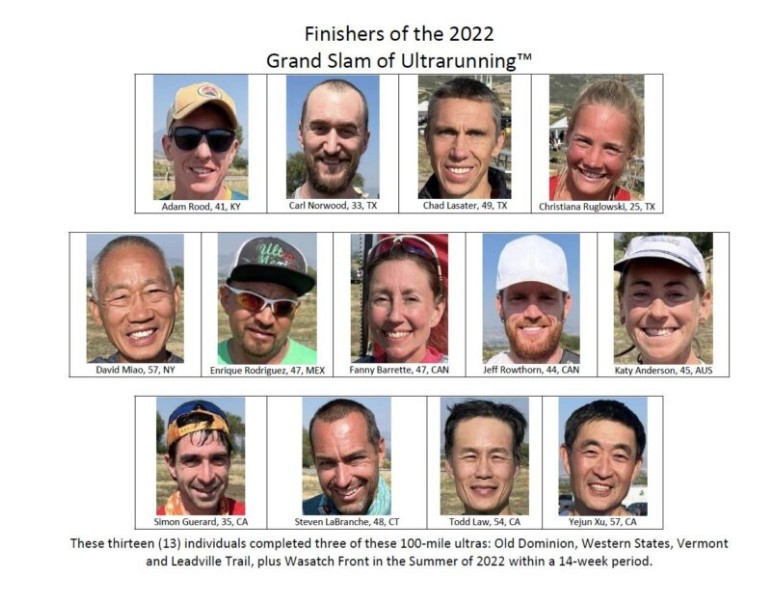
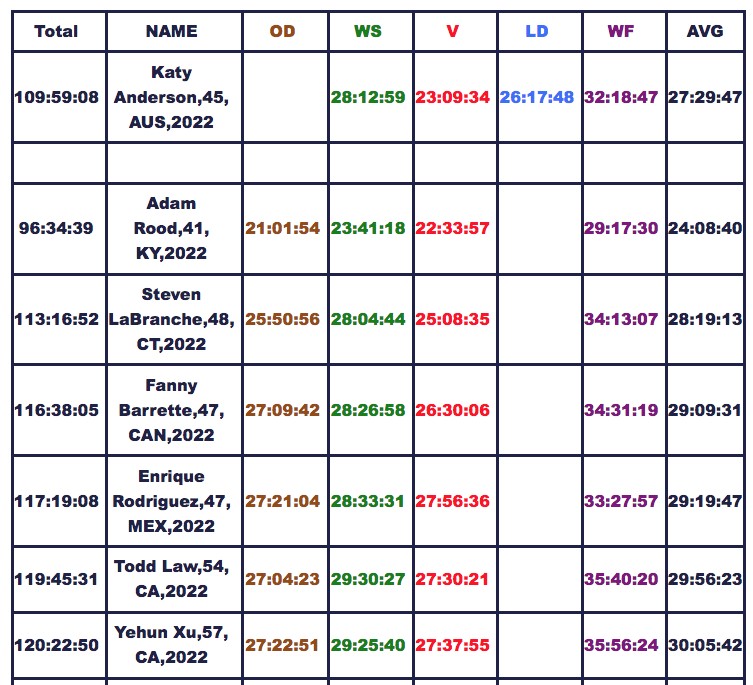
The 2022 Grand Slam of Ultrarunning
The Grand Slam of Ultrarunning was the 1985 brainchild of Fred Pilon, one of Ultrarunning Magazine’s founders. The challenge was to finish all four of the major 100-mile trail races in the United States in the same summer: Old Dominion, Western States, Leadville and Wasatch. Fred contacted Wasatch’s race director, Steve Baugh, to see if Wasatch was interested in organizing the Grand Slam effort and, as the final race of the season, making the award. Steve Baugh enlisted friend (and future Wasatch race director) John Grobben to assist in gaining support from the other 3 races’ directors. In 1986, Maryland’s Tom Green became the first Grand Slam Award winner. As ultrarunning’s popularity has exploded, many of the races have been forced to limit the number of entrants, usually by holding an entry lottery. As a result, the selection of races that qualify a runner for the Grand Slam has broadened.
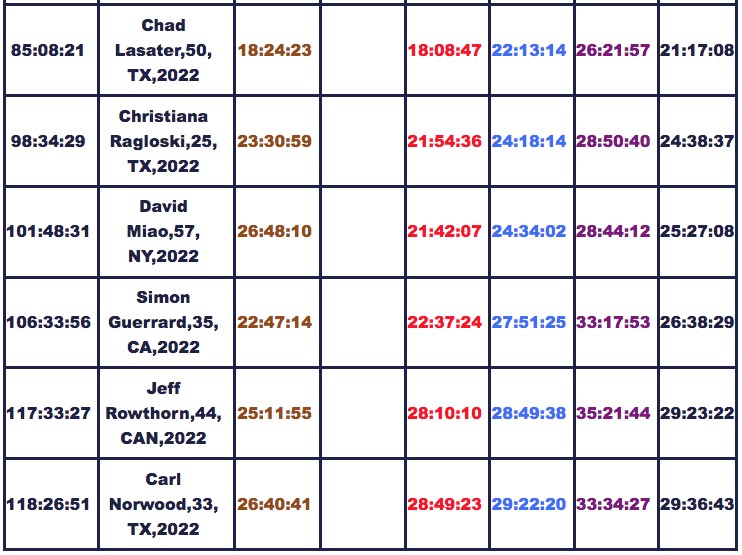
Colleen Ford
First Woman 20-time Finisher
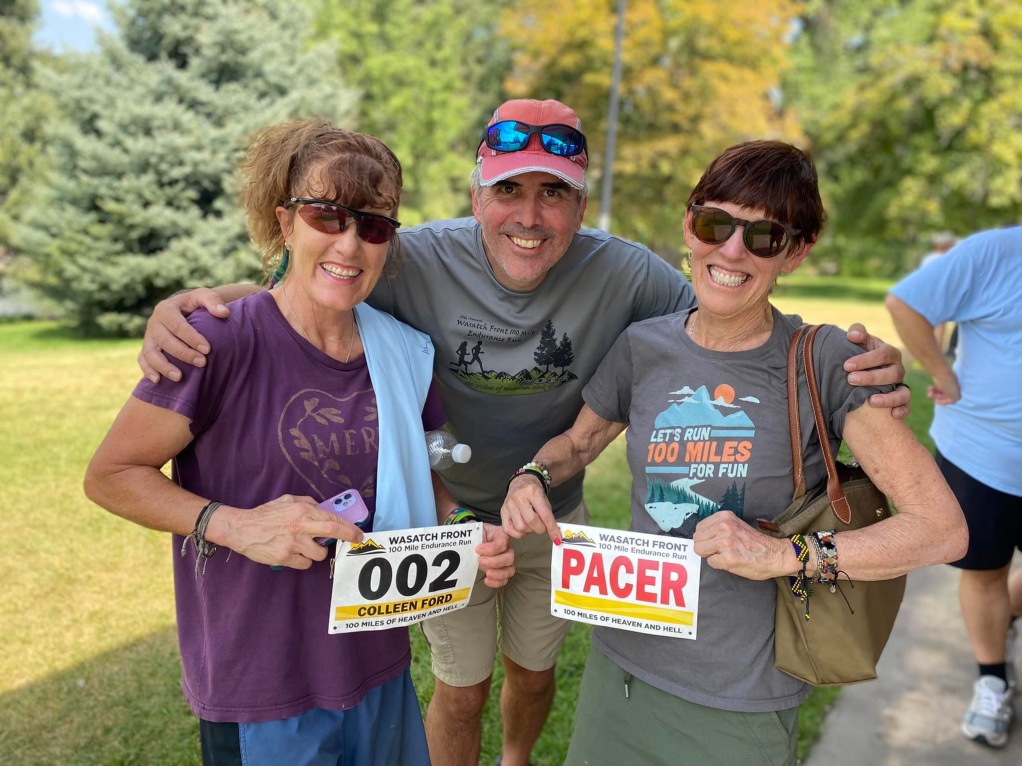 Colleen Ford celebrates her 20th finish with
23-time finisher Max Bliss and pacer Lori Pratt Smith*
60-year old Colleen Ford became the first woman to complete 20 Wasatch 100s, finishing in 35:49. Collen is an ICU nurse at the Huntsman Cancer Hospital in Salt Lake City. Colleen was a “gym rat” who started to run the roads to keep active after her son was born. A workmate steered her to Jeri Sims-Masters for answers to her endless running-related questions. Jeri was a Wasatch 100 veteran and was entered in Wasatch that year (1995). “Why don’t you come pace me?” was Jeri’s logical question. Intrigued, Colleen peppered her with questions: “Are there bears? Where do you sleep? Where do you go to the bathroom?”
Colleen ended up pacing Jeri from Lambs Canyon to Brighton – 25 miles in those days – despite never having gone longer than 13 miles. She recalls thinking: “This is interesting…people are going slow like me and look at all this good food!” A year later, Colleen ran her first Wasatch in 33:09 while Jeri ran a 29:52 PR.
Colleen’s 20th finish didn’t come easily. A “back issue” emerged during the race and got progressively worse. It became a “death march” as the effects of heat and wildfire smoke-induced breathing problems took their toll. By the end, she was doing the “ultra lean.”
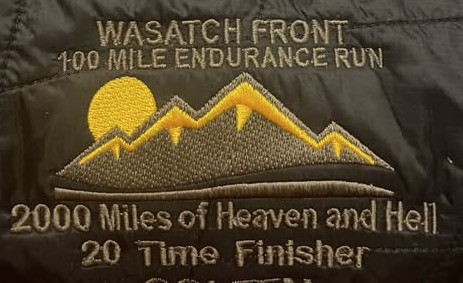 Colleen’s 20-time finisher jacket emblem
2000 Miles of Heaven and Hell
One of the most impressive things about Colleen’s accomplishment is that all 20 Wasatch finishes are 32 hours 46 minutes or slower. She’s not a “speedster” nor does running necessarily come easy for her. Running Wasatch, however, is natural for her. She has an inherent sense of pace and knows how to get the finish line. Her 3 DNFs (one due to injury and 2 because she missed the cut-offs) only fueled her fire to make it to the starting line…AGAIN.
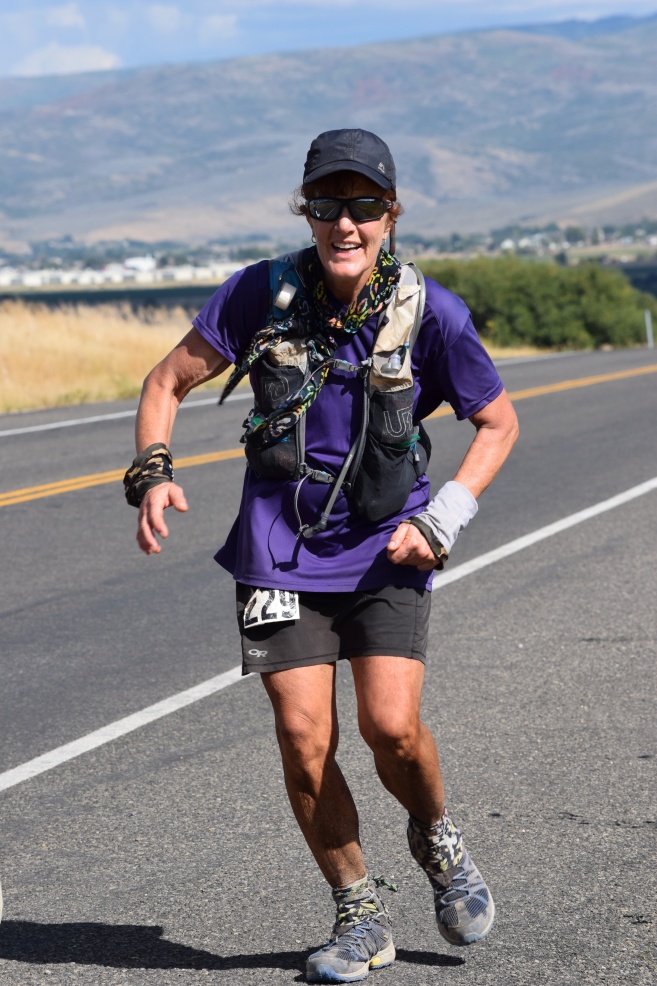 Colleen demonstrates the “Ultra Lean”
on her way to the 2018 finish
Photo courtesy of Dana Miller
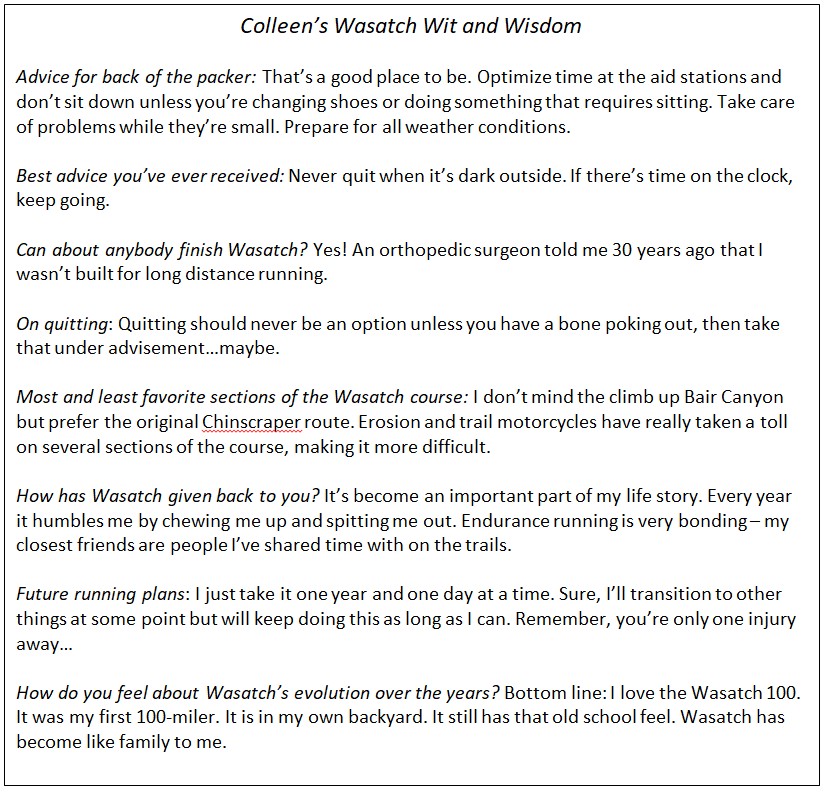
It Runs in the Family
The Holdaway Legacy
Over the years, the Wasatch 100 finish line has witnessed two or more members of the same family finish the race several times. These shared adventures on Wasatch’s 100 Miles of Heaven and Hell become treasured family memories as runners, family-formed crews and friends engage in the struggle together. The Grant Holdaway family epitomizes the strong ties Wasatch can create, ties that often extend to several generations.
The author first remembers then 70-year old Grant Holdaway from the 2001 race, which finished at the Sundance Ski Resort. The trail emerged from dense scrub maples less than 100 yards from the grassy hillside finish. The race clock had expired but there was still one runner nearing the finish line despite heading for a certain DNF. At 5:08 pm, 8 minutes after the race officially ended, Grant Holdaway appeared through the trees to the roar of the finish line throng. Accompanied by some of his children, he appeared to be falling forward towards the finish. As it turns out, that “falling forward form” was just how Grant ran and he’d actually finished the race on his third attempt the previous year in 35:31.
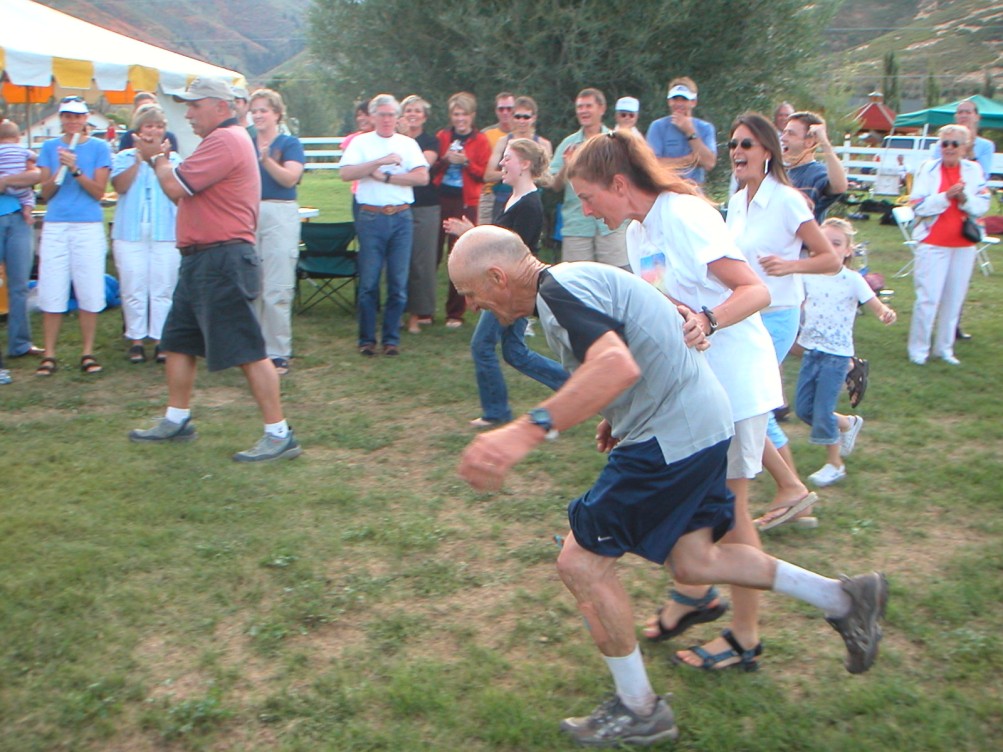 Grant Holdaway finishes the 2003 Wasatch
at The Homestead in 35:58
as daughter Wendy lends support*
Grant’s son, Jeff, remembers that the whole Holdaway-Wasatch obsession began in 1997 when he was living in Washington, DC. His father called and said “I heard about this running thing in the area where we used to camp. It’s 100 miles but they give you 36 hours. We could power walk the whole thing.” Jeff had done a few 5k road races but was excited to help his Dad get to the finish. Jeff reflects: “These moments change your life and how you see the world. It’s been life changing for many in the family.” Jeff finished his first Wasatch 100 in 1998 and has now completed 23.
Wendy, Grant’s daughter, lived in Mexico City where she played bassoon in the National Symphony of Mexico. She joined the family “get Grant to the finish line” project in 2000, helping him to a finish with 29 minutes to spare. Wendy writes:
I found a coach and learned to run and we were off to the 2000 Wasatch 100. I had
understood that I would be pacing him through the night, not understanding that I was
also crew chief, handler and pacer. No GPS, just paper maps, vague driving instructions
and my Dad’s overly optimistic pace chart.
As I left lambs with my father, we were behind his splits and it was up to me to make up
the time. With fading D cell flashlights, sketchy trail markings and 35-degree
temperatures we trudged through the night, singing hymns to keep the coyotes at bay.
We made up the time to Brighton, where I handed him off to Jeff.
I took over again 7 miles from the end. As we crossed the finish line, Dad turned to me
and said “Daughter, I couldn’t have done it without you”, then threw up and passed out.
A small child watching asked his mother “Is he dead?”
After a lifetime of a very tumultuous relationship between my father and myself, we
found a common ground in running and a bridge to facilitate communication.
 Grant gives daughter Wendy a hug
at the 2004 Wasatch finish
Photo courtesy of Wendy Holdaway
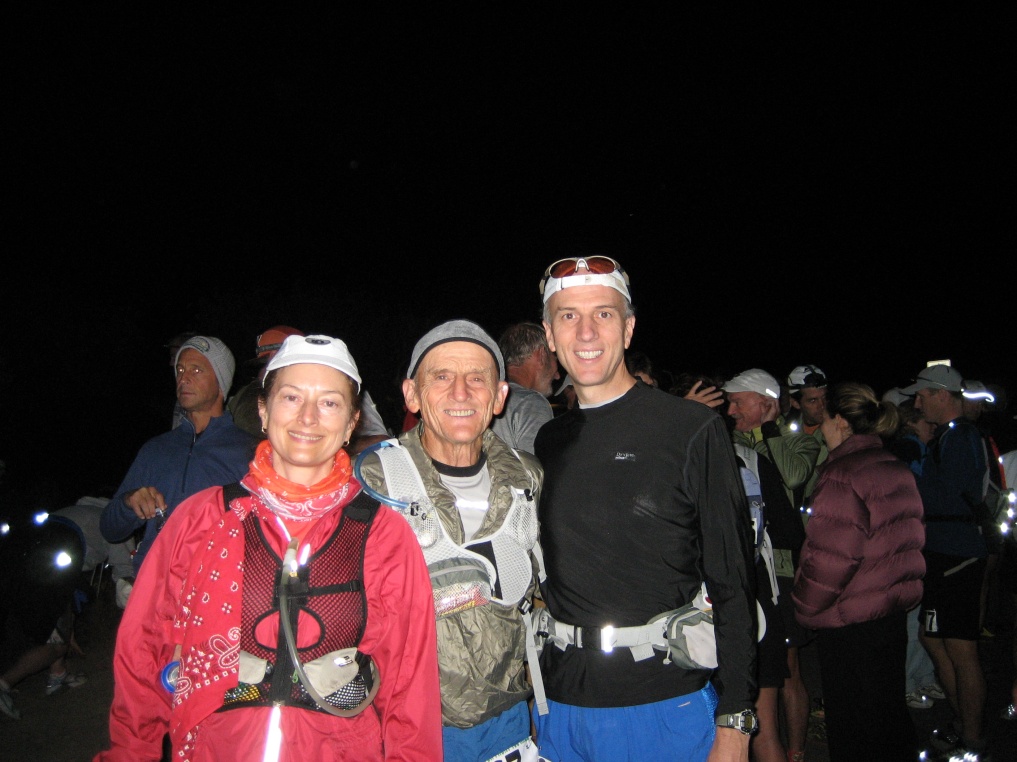 Wendy (left), 75-year old Grant (center) and Jeff Holdaway (right)
at the 2006 Wasatch 100 start*
In 2013, Jeff completed Wasatch with his son Chris. In 2022, sons Cameron and Matthew joined him with all 3 making it to the finish line. That makes 30 finishes for the Holdaway family but they’re not done yet…
Grant continued running trail ultramarathons, finishing his last 50-miler in 2017 at age 87. Grant passed away in 2020 but left a lasting legacy.
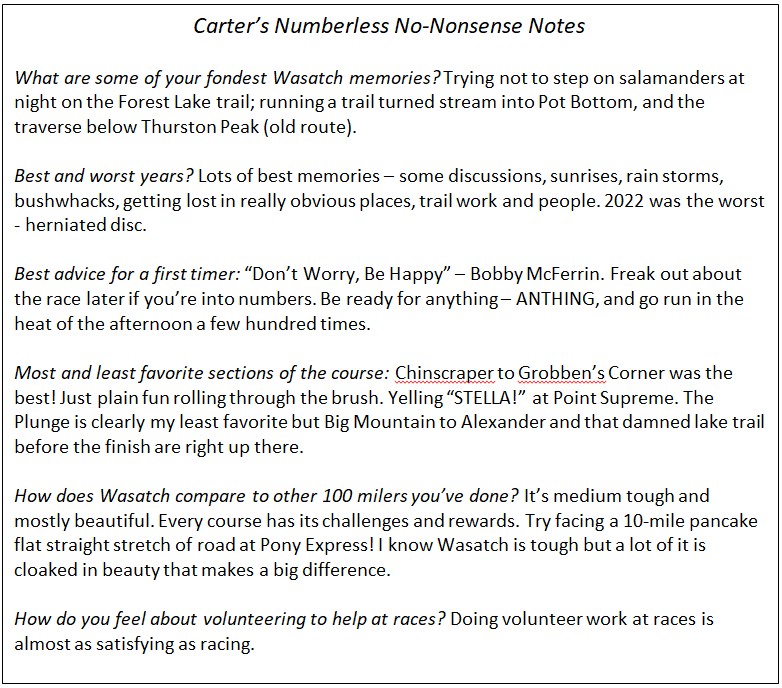
Carter Williams
20-time Finisher
64-year old Carter Williams finished his 20th Wasatch 100 in 35:12 with a herniated disc. When asked which of the 20 was the worst, 2022 was it. “I did it because it was the 20th. I learned a lot of new stuff at the back of the pack, so even that wasn’t too bad,” he quipped. Remarkably, he finished those 20 races in the span of just 21 Wasatch years. He missed one year because he was teaching English in China and soon realized that running through mucky air at 4:30 am in 90% heat and 95% humidity wasn’t working.
Carter, a retired teacher from Salt Lake City, ran his first Wasatch 100 in 2001, finishing in 30:35. He credits his longevity to ultrarunning’s therapeutic nature: “It’s really my therapy. Maybe it is inadequate therapy, but there it is. I run almost exclusively alone, so it gives me time to let my mind wander and, I believe, flush some junk from the system.” He confesses that he’s “not a numbers guy” and speculates that he might be faster if he was but that’s not what he needs from running. “THE key: I know that I always feel better after a run on trails, and the race gives it a reason,” he explained.
Not being a numbers guy, Carter doesn’t know how many 100-milers he’s done: “I have no idea…probably around 80 or 90.” Needless to say, he’s had a lot of time to think and declutter his mind.
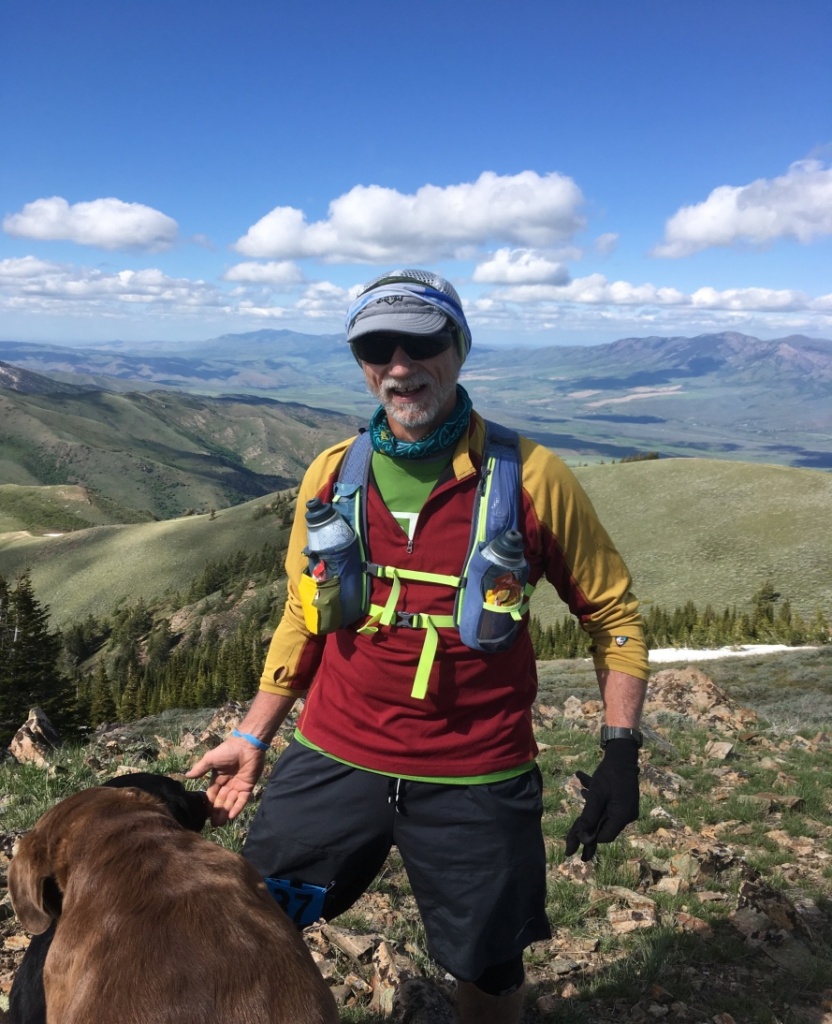 Carter Williams in one of many Wasatch Range
therapy sessions*
*Photos courtesy of the runner(s) pictured unless otherwise noted
@1980